Cougars: fears in the dusk

When I first moved to Monkey Valley, my biggest fears were attack by cougars, bears, and humans. I’ve already documented some of the encounters with humans. Pretty innocuous, and nothing like my late-night imaginings of a Charles Manson-like gang bent on my murder.

So it is with cougars. Due to my enjoyment of running in the wilderness, fear of Beautiful cougar of my dreamscougar attack has seemed to be the biggest danger I would realistically face at Monkey Valley. Especially since I usually run at dusk, which is when I imagine the cougar is most active! I remember hearing a few years ago (or was it six years ago now?) that a jogger was attacked on Vancouver Island. The writer of the news story made a joke about joggers persisting in wearing lycra leggings and behaving like deer, as if we are practically begging cougars to attack!

Soon after moving to Monkey Valley, I was driving along a logging road about 10 KM from my home when I was graced with the very rare sight of a cougar in the distance. It crossed the road in front of me, several hundred yards ahead, and leaped up an embankment and disappeared into the woods.

Its grace and power was amazing to behold. It sprang up a bank that was eight feet high or more, compressing its haunches and making the leap in a single bound. It was a beautiful tawny burnished goldy-red colour. Gigantic! I would guess at least six feet long. So incredibly, obviously powerful and alive. The encounter was such a brief flash, but its memory has stayed with me all these years. My impression was that there was no way I was a physical match for this creature that was bigger, stronger, faster, and way wilder than me!

Previously I had imagined the cougar as little bigger than a coyote, and nothing to really be afraid of. But now that I’d seen with my own eyes its size and physical power, I knew that it could kill me with ease, if it chose to. I’ve spent a lot of time contemplating the size of the deer, the cougar’s favourite prey, versus the size of me. Only a few pounds difference, most likely. And the deer run a lot faster than I do!

One of the ways to deal with fear is to find out the truth. I did some research on cougars, reading up on them in Mammals of British Columbia, and learned that their territory can be as big as 100 square miles. I hoped that this meant the chance of my being in the exact spot as the cougar at the same time was very slight. But this didn’t really help assuage my fear. And one spring, Bob Ross of Merritt’s Tri-Ross Construction, who with his son Brent has done a lot of construction work for me at Monkey Valley, found cougar tracks in the mud by the barn. I examined their large size, and was struck with fear again. Clearly I was living in the cougar’s territory. There was no denying the potential for an encounter… (to be continued)

Holy cow, a visiting vole!

The other night I was wakened from a peaceful sleep by a crinkling sound. It’s not the first time this has ever happened, but it’s been a while. I replayed the sound in my head, and figured it wasn’t a human intruder—the sound was too small. It could be a pack rat, I thought, remembering that there is an unwanted pack rat living under the house at the moment. It might have come in the cat door…

But the sound seemed even smaller than that. Maybe it’s a little mouse that found its way in through a tiny hole, I thought. Donald was on the bed beside me, also listening. But he didn’t seem inclined to get up and go investigate. I decided I didn’t want to either, and hoped that maybe Donald would go catch it later. Then I promptly fell back asleep.

The next morning I went to investigate the little package of poisoned bait that I keep behind a bin in the loft. That seemed to be where the sound was coming from. There were a few loose kibbles around the package. Sweeping the floor downstairs I found some more clues: a kibble on the living room floor, and  a few tiny droppings near the bait behind the stereo. Hmm…Western heather vole

Then I heard Donald playing in the bathroom. That can only mean one thing. He has found a playmate. Sometimes he finds them outside and brings them into the bathroom to play with. Other times, as in this case (I do believe) he found one inside the house. The downstairs bathroom is black, because all the bathrooms and showers in the house are painted the colours of the medicine wheel: red shower, yellow shower, black bathroom, white bathroom. Donald likes the black bathroom as the place to play with his prey. And there he was, grabbing something in his mouth and flopping it around and letting it drop. He did that a few times, but the poor creature seemed dead, so I left him to it.

When I went back later to investigage, I found the corpse of a tiny little vole in the bathroom. Thinking I was being somewhat morbid, I brought Mammals of British Columbia into the bathroom and made an identification—definitely a vole, with its tiny size and short tail, and the shape of its nose. But what kind of vole? I went to get my tape measure, and measured the tiny creature. It was about 11.5 cm long, including a tail about 2.5 cm long. It looked like a lot of the voles in the book, brown with lighter underside, but the only vole whose size can be under 12 cm in length is the Western Heather Vole. I learned it feeds on green vegetation, grasses, lichens, berries, seeds, and fungi. Lots of those things around here. And it likes the inner bark of various shrubs from the heather family.

White mountain-heatherThat led, of course, to a consultation with Plants of Southern Interior British Columbia. Is there really heather around here? I learned that there are two kinds, white mountain-heather and pink mountain-heather. They are tiny shrubs, only 30 cm and 10-40 cm tall, respectively. They have blue-bell shaped flowers, and the pink ones do look familiar to me. But I am not certain if I’ve seen them. Clark, quoted in the guide, wrote “These cheerful bells ring an invitation to high places above the timber line, to those serene and lofty slopes where peace and quiet enter our Pink mountain heathersouls.”

And so the cycle is complete, from crinkling in the night to peace and quiet entering our souls. I took the dear little vole and put her body under a young fir tree that grows near the house, and wished that her spirit may be at peace.

If you are interested in reading about other visitors to Monkey Valley, see these posts:

Thanksgiving and appreciation

Appreciation can feel like a soft pink cloud insideMy Diamond Approach group met in September and we explored the topic of appreciation. Have you ever felt an upwelling in your heart as you think about a person, appreciating him or her, or perhaps appreciating something they’ve done? Appreciation can cause an open warm feeling in the heart. It can be tender and sweet, light and delicate, or deeply yummy like a baby whose cheek or arm you’d like to bite.

At the DA weekend I was mostly resistant to feeling this kind of sensation. My heart was pretty closed, well-protected, and I felt like keeping it that way. As it happened, there were moments working with others where the vulnerability of the exploration we were doing just naturally caused my heart to open. In some case to myself, and in other cases to the other. But at the close of the weekend something happened that irritated me and that I allowed to close and harden my heart again. This is just the nature of the work! At the point in my inner journey that I’ve been occupying this year, I’ve been letting myself be hard, closed, irritated, or whatever is there, with a little bit of clear space around the experience that’s big enough to hold it. There is a gentleness about accepting my experience rather than rejecting it and trying to change it. There might be some self-indulgence too. But no one can force their heart to open.

Perhaps the recent DA weekend was still working in me the other morning when I read a 2006 article in the Globe and Mail, part of a stack of papers my friend Geoff Blake saved for me a few years ago, for use in starting fires in the wood stove. The article was about parents who send their kids to summer camp. It was somewhat sentimental and also humourous, about how parents enjoy having the time to themselves while the kids are gone, but worry about them until they know they’re having a good time. It made me remember that my parents sent me to summer camp one year. And suddenly, for the very first time in my life, I understood and appreciated how much my parents had made the focus of their lives caring for my sister and me (and later for two more sisters and a brother).

I’ve heard the Christian crap about honour thRainbow gardeny parents, and due to various childhood events that hurt me I never bought it. I thought my parents did not deserve to be honoured. That they had failed me so utterly I would never forgive them. I’ve done a lot of work to get through this. Therapy, spiritual work, and wilderness work including vision quests and other nature retreats. I’ve made conscious choices to heal, and done a lot of that. But suddenly, this Sunday morning before Thanksgiving, I was able to understand and appreciate my parents in a new way. To open my heart and feel the love and caring they showed in their choices and actions as parents. I cried for a while, and moved by this experience, cried many times throughout the day.

Wow, so this is what it feels like to be a normal person who feels her parents cared for her! I feel moved by so many aspects of the parent-child relationship and bond. With this comes a feeling of fragility, though. A poignancy about knowing these relations all come to an end. My dad died in 2000, long before this understanding blossomed in me. I shared my appreciation with my mom though (on Thanksgiving Day), and, due to a friend’s mother dying recently, feel the tug of fear and loss that will come with my own mother’s death. (Unless I die first, of course.)

We are so fucking vulnerable as humans. I don’t know how we manage to stand it. I think closing down the heart a little is probably a pretty popular defense.

Anyway, in closing this musing about thanksgiving and appreciation, I want to mention a few other things I am thankful for.

  • The black ghetto-blaster my sister Kim gave me in my early 20s. It has been working for several decades now! Lately I’ve been using it to listen to DA teacher Karen Johnson’s tapes on relationships while I do crunches. I feel grateful to Karen for the tapes, too.
  • Our dear earth mother, for nourishing me from her body with the food and water I enjoy every day. And all the people who raise, transport, and sell the food. And myself for preparing it.
  • My sister Katherine, for offering to come to Monkey Valley to spend my birthday with me.
  • My cat Donald, for his companionship, purring, and never being fake with me. If he doesn’t want me to pick him up he growls. If he doesn’t want to come home, he stays out!

I could go on… I spent a lot of the day on Monday thinking about things I am grateful for. Probably the warm humanness that keeps us all struggling on, doing our best, is what moves me the most in this moment.

Thanks to you, too, for reading and having your own response to what I’ve written.

Is that a spotted owl?

Photo by Katherine Rempel.

On Thanksgiving Day, which is also the US Columbus Day and Indigenous People’s Day, I looked out the bathroom window and saw a large white blob on the top of a tree. Was it snow? But no, none of the other trees had white blobs on them.

So I went across the hall to my office loft to get the upstairs binoculars, and grabbed a note pad. If this was a bird, I was going to do it right and note all the pertinent details! Luckily the bird, it was, was still there when I got back. It was a very large puffy-looking brown bird, with a big white bib. That was the white blob I’d seen with my naked eye.

I noted that it had a pale beak and yellow feet. It had a white spotted pattern all over, chest and sides and possibly back, in a fairly regular pattern. It seemed to have white on the crown, and I noticed brown streaks on its neck, in the white. Wow, I felt like I was getting good at this! And I felt so happy to have this visitation on Monday morning, Thanksgiving Day.

The bird stretched its wings out a little and I noticed it had fat feathered thighs. Then it spread out its wings and tipped off the tree top, slowly soaring down into the valley below. I watched a few minutes to see if it would reappear with some prey in its beak, but it disappeared from view and I didn’t see it again.

So I went with my notes to check the Sibley guide. The owl section quickly showed me that this bird was not an owl. Its head was too small, and it didn’t have disc-like eye areas. So turning to the next likely suspect, I discovered my old friend the red-tailed hawk. I made a positive identification. This one was a juvenile, which is why it had the white bib. Aha!

I look forward to seeing it age and change colours! I had a peek in the Audubon guide too, just to see the pix there, and noticed they describe the call as a “high-pitched scream with a hoarse quality, keeeeer.” Whereas the Sibley guide describes the voice as “a rasping whistled scream cheeeeeew falling in pitch and intensity.” I favour the keeeeeer myself, and this is the noise I attempt when talking to the hawk as I run by.

Red-tailed hawk has long been a resident in my valley, and now it is clear that the hawks are carrying on. Fooling around with each other, too! Their presence here is something I am very grateful for. In the early evenings of winter, sometimes the hawk circles above and calls out to me when I go for a run. They have been a faithful companion over the years, when it is quiet and lonely here.

I am thankful.

Why Amazon?

Complete Beading for BeginnersYou might have noticed that when I refer to a book in my blog I usually include a link to the book on Amazon.ca or Amazon.com. An exception to this is when the book is available from Lost Borders Press. I want to support Meredith Little, who operates Lost Borders Press and who with her husband, Steven Foster, co-founded The School of Lost Borders.

I do this because of the value I find in looking up books on Amazon. It’s often possible to look inside the book, get reference info, and read people’s reviews of the book. When I want to buy a book that I can’t find at my local bookstore I look to Amazon.ca first, then Chapters.Indigo.ca. I prefer to buy from a Canadian site, in Canadian funds, with Canadian shipping. But if neither of them have it, I try Amazon.com, and then online used book sellers.

If it happens that you are interested in the book I mention, the link gives you the information you will need to find the book, such as the name of the publisher and the year it was published. Whether you want to get it from the library, buy it at your local bookstore, or buy it online.

Another reason I like Amazon is they sell my book! Complete Beading for Beginners. Or if you’re American, Complete Beading for Beginners! Of course, you can also pick it up at Country Beads on West 4th Avenue in Vancouver! Or at Beadworks on Granville Island. Not that I am trying to get you to buy my book!

In general I am opposed to having advertising on this web site. I hope that the links are subtle and don’t make you feel like I’m trying to sell something to you, because I’m not. Though if you decide you want to buy my book, that’s great! 🙂

However, I do want to let you know that I participate in Amazon’s associates program, at the urging of my friend and blog consultant, John Harper. What this means is that if you happen to click on a link to Amazon from my site, and buy anything on your visit to the Amazon site, I get 4% of the sale. But don’t worry, I’m not counting on this to fund my retirement! It is fine with me if you never click any of the links in this site.

Roads, signs, and what the heck is Mercury retrograde?

Starshine signWhat the heck is Mercury retrograde? On this blog I have been talking about the Four Directions model of noticing how humans are part of nature’s cycles. Being in rhythm with these cycles can help us flow through our lives more smoothly. It doesn’t make sense to plant a seed in the frozen ground—knowing how the cycles work tells us that the spring is the best time to plant most kinds of seeds, and this knowledge can guide us in knowing when to start new projects too.

Just as we are affected by the changing seasons, the cycles of the stars and planets can affect us too. And once every three months, the planet Mercury appears to move backwards in its orbit (retrograde) in relation to the earth. Of course it doesn’t actually turn around and move backwards, but it looks like it does, and for many of us, this period has a noticeable impact.

In astrology, the planet Mercury rules communications, travel, electronics, and equipment with moving parts. During the period of Mercury retrograde, any of these things can go awry! If a piece of equipment is about to break down, it will most likely occur during MR. Travel plans can have kinks and delays. It is a terrible time to sign contracts, because some key piece of information will be missing. It will sure enough come to light after Mercury turns direct, and make you rue the day you bought that new laptop!

Some examples from the current MR period for me: I ordered the new road sign for Starshine Way, and a month later I learned that Fun-Key hasn’t started working on the sign—they haven’t even ordered the plate to put the letters on, and can’t order it until they get enough sign orders to make a bulk purchase worthwhile. As another example, I’ve been waiting since September 12 for a quote from VSA for the snow plowing, and finally I heard from them that they can’t give me a service contract for my road. It will be third-priority, and if I can get them to do it at all I will pay an hourly rate based on the type of equipment they use. Neither of these things is a big deal, but it is a stalling of forward movement. What I wanted to resolve is still unresolved. I have to find someone else to make the sign, and some other way of getting my road plowed. (And BTW, in a previous MR period, when my laptop died, I did make the mistake of buying a new one. Great price. What I didn’t realize was that it had Windows Vista, and I would have to buy all new software to run on it!)

So what is the positive here? What is MR good for? As the “re” in retrograde hints at, it is a good time for re-doing things. Re-writing. Repairing. Rewiring. It is also a good time for researching. It is a great time for reconnecting with people from the past. Revisiting a favourite place. You might be surprised if you start paying attention to MR periods and notice how a relative or old friend pops up out of the blue during this period. Or perhaps you have a sudden interest in making contact with a friend from the past. 

And what about rest? That begins with “re” too. And resting fits with the season of the West. The fall is the time when the black bear goes into her den, earthing herself for a time of hibernation and turning inwards. After the busy outward activity of the summer, it is good to take a rest! Can you give yourself the space for a retreat this October? Some time and space for yourself? Sometimes that’s the best thing to do during Mercury retrograde.

One good place for a retreat, near Merritt, is Dhamma Surabhi, the Vipassana Meditation Centre of BC. Ten days of silent meditation!

Coming home to Monkey Valley – October

I actually come home to Monkey Valley quite often. Usually, I make two trips a month to Vancouver, which means I get to come home to Monkey Valley twice a month. The previous post gives some background on why I was away so much before the September homecoming.

Originally, I began living at Monkey Valley full-time and year-round in October 2002. But having been away so much in the past two years, my psyche doesn’t know where home is—here or in Vancouver. This could be considered a question of the West, returning to the theme for October. Who am I? Where am I? Where is home? Where do I feel at home?

Is a bear at home in the woods?This time on my way home, I had a wonderful greeting from the West. As you know if you’ve been reading about the Four Directions, the West is the direction of the fall, and of earth. But you might not know that the animal for the West is the bear. Especially black bears. And that’s who greeted me just after I’d driven through the Kentucky-Alleyne campground, between the two lakes of the same name.

The type of topography found here, known as kame and kettle topography, consists of many hills and depressions, and illustrates a glaciated landscape. There are azure lakes set in grasslands, surrounded by forsts of pine and fir. The Kentucky and Alleyne lakes are an incredible greeny-blue colour. If you’re interested in some beautiful footage of this area, check out this You Tube video.

Suddenly, as I eased around a curve in the road just after the campground, there was the cutest little black bear crossing the road in front of me. I was driving very slowly because the speed limit through the campground is 20 KM/H. Donald was laying on the dashboard, and he made a startled sound when the bear appeared. We watched him cross in front of us and then amble into the woods. I grabbed my cell phone, opened the window, and got a few pix of him! (One of the things you get to enjoy on this blog is my blurry blob-like photos of wild animals!) He took his sweet time walking away from the car, moving through the trees.

The bear is very special to me, and I’ll tell you more about that another day. My heart feels glad when I get to have a glimpse of or encounter with this magnificent furry creature. May your encounters with bears be safe and gladdening too.

Coming home to Monkey Valley – September

Corner of Loon and DillardOn Wednesday, September 10, I came back to Monkey Valley. This might not seem remarkable to you, but it was a very exciting day for me.

You see, in November 2006 I went to Vancouver expecting to return to Monkey Valley in a few days. But there was a big snow storm, and VSA, the highway maintenance company, didn’t have time to plow my road because the snow just kept falling on the Coquihalla and the connector to Kelowna, and my road was not a priority. By the time they could get around to plowing my road, in late December, there had been more snow and a thaw and freeze, and it would take a caterpillar to break through the four feet of frozen snow! Estimated cost: $1,800!!

I decided to spend the winter in Vancouver, paying extra rent on my apartment there because I would be there full-time rather than part-time. Additional cost for five months: $1,500. I thought I’d rather pay the money to my friend Geoff than to VSA.

However, there were some hidden costs I didn’t realize at the time. Mail forwarding: $300. Tank full of propane, which was drained over the winter because I’d left a small propane heater running to keep the house from freezing while I was gone for “a few days”: $1,800. Cost to repair frozen plumbing, which occurred once the propane tank ran out: $500. 

Oh well! I had a fun winter in Vancouver, and even enjoyed a weekend visit to Monkey Valley when my friend Marvin and I snowshoed in. This was a 7.5 KM trek from the corner of Dillard and Loon to the house but, unbelievably, a couple on a snowmobile was driving by just as we were preparing for the hike in, and they gave us a ride! So we just had to trek out. 

That was in April 2007. In May I was able to drive in to Monkey Valley and pick up my camping gear. Then I was off for a summer of travel and training. I went to Boulder, Colorado for my graduation from Naropa University, and then did five vision quest retreats and trainings, and went to the Diamond Approach summer retreat, and went to a yoga teacher training in Mexico. By the fall of 2007 I was exhausted! But I also needed to look for work.

So this meant I decided to spend another winter in Vancouver. I prepared the house for winter as best I could, and said goodbye to Monkey Valley in November 2007. There were still some burst pipes the following spring, although I had done my best to drain everything! Plumbing is a big expense at Monkey Valley! Anyway, the plumbing was repaired over several trips home, with help from Nicola Valley Plumbing and Active Mechanical. Russ with Active Mechanical set up my solar hot water heating system, and he fixed that part of the system, while Nicola Plumbing repaired some leaks in the house.

But with looking for work and some more travel for training and retreats, it wasn’t until September 2008 that I actually was able to return to Monkey Valley “full-time.”

So it was a very happy day when I drove in to Merritt with my cat, Donald, and a car load of small household items that had found their way to Vancouver over the previous 22 months.

The first order of business was to cancel the mail forwarding. Once again I get to enjoy the thrill of going to the post office and checking my box for mail! Next, I went across the street to Interior Savings Insurance to pay for my annual house insurance policy. I stopped by VSA to ask for a quote on getting my road plowed this winter. I went to Fun-Key Enterprises to speak with Susanne and Tim about getting a new road sign made. Last year, my Starshine Way road sign was stolen a mere two days after my friend Eric and I had installed it! And finally, I went to Espresso Etc. to have a decaf and say hi to my friend Janet and her husband, Frenchie, to tell them the great news that I was coming home.

It Was a Happy Day!

The mystery of the West

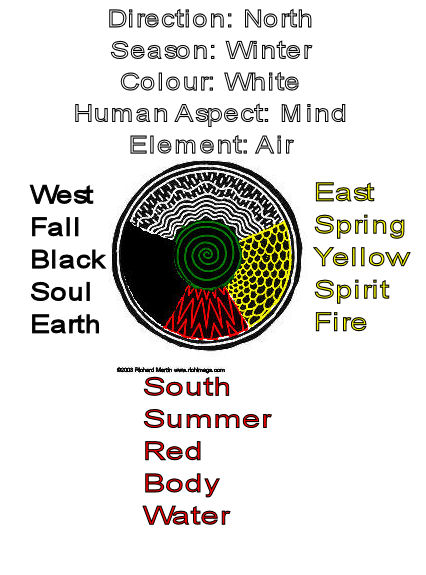
Overview of the Four DirectionsThe West asks us: Who am I? What in me is dying?

It is the place of oncoming darkness, endings, mystery, shadow, subconscious, dreams and visions, soul, self-discovery, introspection, introversion, transition, descent into the depths of the psyche, and inner power.

Here we wrestle with adolescence and grow toward individuation and our adult-self.

Here is the dark night of the soul.

This is the place where we earth ourselves.

The Passage: Soul Initiation

Initiation into adulthood occurs the moment we commit to the embodiment of our self-knowing in the world. Taking our self-awareness and self-understanding, we find a way to bring our gifts forth to our people. This is when we move around the wheel, from West to North. We move in the next direction clockwise, with the movement of the Earth. With the movement we find balance.

If we get stuck in the West, it can show up as addiction to introspection, dark moods, depression, our shadow selves. We are taking too much energy from the East, not allowing that part of ourselves to have expression. Sometimes we get stuck in depression, grieving our losses too long. Or we might identify ourselves as victims.

Ways to move to the North if we are stuck in the West

* Find a way to give service to others. Volunteer.

* The elements always evoke the direction, so working with the elements can be a tool. Go out on a windy day and feel the wind sweeping through your soul, emptying you.

* Watch birds, a beautiful expression of the air element.

* Go out into nature and make a tool.

* Make a gift for someone.

* Focus on the colour white. Watch white clouds in the sky. Contemplate a piece of white cloth or paper. Paint something white. Wear the colour white.

Wild women run in the dark!

Dark mountainside - Edited free pic from http://www.digital-cameras-help.com/landscapes.html?id=14The West is the place of darkness, black, the night. I wonder if night owls enjoy hanging out in the West part of the wheel, and early birds prefer the East.

For just about as long as I’ve been running (since I quit smoking for the first successful time—lasting three years—in 1996), I’ve run at night. Not always, but when life’s demands take up all the daylight hours. People have various reactions to this, but it’s usually a mixture of shock and concern. Fear of the unknown, I think. With one boyfriend, it was a surefire way to know he cared for me (and engage in some negative merging). All I had to do was mention a night run and he’d freak out!

Running at night has an entirely different feel to it, whether in the city or in the country. In the city, I find it is way more peaceful to run after dark, when people are at home and asleep. The humming vibration of the city settles at night. Even those I might encounter out walking their dogs are shrouded in darkness. It is easier to ignore them, to stay in my own inner space. There is an unspoken agreement among the night walkers, to respect the privacy of the darkness.

The meditative space of night running is something I love about it. There’s not much to look at, so the feel of the running becomes the rhythmic back section for reverie. It’s easy to sink into an altered state of awareness, imagination, inspiration.

Led Zeppelin - Early Days, which I bought for a road trip last yearLast night I ran in the misty mountain darkness of the Lower Seymour Conservation Reserve. Listening to Led Zeppelin (what is and what should never be, the battle of evermore, when the levee breaks) on the drive out there helped set the mood for entering a magical land of darkness. I parked on Lynn Valley Road, due to the ridiculous parking restriction of 6 PM in the LSCR parking lot. Crossing the wooden footbridge that arcs high above Lynn Creek, I entered the darkness of the woods.

It took about eight minutes of gravel trail running through the woods to get to the LSCR parking lot. As I first entered the woods thoughts of mountain lions crossed my mind. For some reason they always do on this stretch of road! Dressed all in black, maybe I could pass for a bear. But my roar just wouldn’t have the power to convince! Anyway, with this lame strategy in place, I continued on to the LSCR parking lot and from there onto my favourite loop trail, down the Twin Bridges Trail to the Seymour River, following the river North along Fisherman’s Trail, and then up the bun-burning Homestead Trail back up to the parking lot.

I’ve done this loop at least 100 times over the past five years or so—probably more. I’ve done it walking in the dark with a friend, so I know which parts are the blackest. I wasn’t worried about losing my way or falling into a pit or off a cliff! I could just let my feet and belly find the way as I sensed into the deep mystery of the night. It is hypnotic, the way a luminous white sheen fills the air on the trail in front of me. This effect is heightened when there is a mist like last night.

Dark forestI was just enjoying this luminosity, and the rhythm of the running, as I ran down the long easy stretch of Twin Bridges Trail. Then suddenly I heard a sound like a chicken crowing, about chest height, in the trees ahead and to the left. It was so loud and close, I stopped for a moment. My mind translated the sound into a human imitating a chicken, trying to attract some kind of night bird! It didn’t feel totally threatening, but I was definitely startled. The call was such a definite pronouncement, I said “Oh, really. Are you sure about that?”

Only silence answered, so I continued on. I realized as I replayed the sound in my mind it must be an owl call. It was a new sound for me, accustomed to the call of the great grey owls at Monkey Valley. Although it had a hooting quality, the range and pattern of notes was more complex. I’ll have to look it up in the bird books when I get home, and see if I can find out who was greeting me in the darkness of the misty autumn woods.

Like the music before the run, this encounter supported the magical feeling of running in the night. It was a blissful run right until the end, an hour later, back up the paved access to Lynn Valley Road. Wild women run in the dark!

Taking a night walk (or run) is always a good way to explore the territory of the West. Try it!

P.S. For those who might be feeling confused right now, I keep an apartment in Vancouver as well as my home at Monkey Valley. This was a Vancouver night run, in the North Shore mountains.